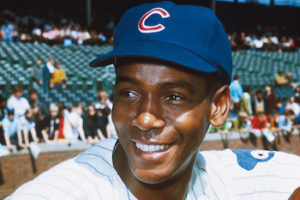
Ernie Banks
*Ernie Banks was born on this date in 1931. He was a Black baseball player.
Growing up in Dallas, Banks had to be bribed with nickels and dimes by his father to play catch. Banks, more interested in softball than baseball, was a high school star in both football and basketball and once ran a 52-second quarter mile. At 17, he signed on to play baseball with a Negro barnstorming team for $15 a game. Cool Papa Bell later signed him for the Kansas City Monarchs.
He returned to them after two years in the army, where the Cubs discovered him at the end of the 1953 season. The 22-year-old went to Chicago and hit his first homer on September 20, 1953, in St. Louis. He quickly replaced Roy Smalley, Sr., as the regular Cub shortstop in 1954. Starting with his first game in 1953, he played 424 consecutive games until fracturing his hand midway through the 1956 season.
From 1955 to 1960, Ernie Banks hit more homers than anyone in the majors, including Mickey Mantle, Willie Mays, and Hank Aaron, and he finished his career with five seasons of forty or more home runs. In 1959, he became the first player in National League history to win consecutive Most Valuable Player trophies, a year removed from setting an NL record for homers by a shortstop with forty-seven.
After retiring from the major leagues as a career Cub in 1971, Banks became the first Cub to have his uniform number retired. 1977, Banks was elected into the Baseball Hall of Fame in Cooperstown. Chicago fans will always remember him as the ballplayer who said, "What a great day for baseball! Let's play two!" He will always be "Mr. Cub," the most popular player the team ever had. His sunny personality is legendary.
The first Black player on the Cubs, Banks came up as a shortstop, where he won consecutive MVP awards but played more games at first base. He is also one of a handful of Hall of Famers never to get into postseason play.
Banks was simply one of the best to play the game on the field. Over those 19 seasons, he hit .274/.330/.500 with 2,583 hits, 512 home runs, 1,636 RBIs, and 1,305 runs scored. Those numbers earned Banks 14 All-Star Game selections and two MVP awards, in addition to baseball's ultimate honor, induction into the Baseball Hall of Fame. Banks was inducted in his first ballot, receiving 83.8 percent of the vote in 1977.
Banks was the anchor in a lineup featuring Hall of Famers Billy Williams and Ron Santo. For a time, he was also an anchor on the field, spending many of his early days manning shortstop, baseball's most important defensive position. Most importantly, though, Banks was an anchor in the clubhouse and in the community, always offering an optimistic take or inspirational word to brighten the team's outlook or the day of a fan he'd only met moments before.
His most famous saying – "Let's play two!" – speaks to the seemingly endless enthusiasm with which he played and lived. If he could have, he would have played two every day and maybe even three if someone asked. That never changed, even as the organization he loved moved further and further from a World Series victory. It's also a shame that Banks won't live to see a Cubs world championship. But there's no doubt he'd smile and say he'd be happier for the fans who will eventually enjoy that moment.
Not only would Chicago be the only stop in a baseball career that spanned 19 seasons, but it's where his heart remained for 43 years after his retirement. He loved the city, he loved Cubs fans, and he loved being their ambassador to points all over the world. Ernie Banks died on January 23rd, 2015. The sports world immediately took to Twitter to react to his passing. He was a one-of-a-kind baseball player and a one-of-a-kind person who defined everything good about sports. But the entire world was better off for having known him.
20th Century Baseball Chronicle
Year-By-Year History of major league Baseball
Copyright 1999, Publications International Ltd.
ISBN 0-7853-4074-2